A city in the United States has taken an unusual step in artificial intelligence regulation, voting to prohibit the distribution and deployment of superintelligent AI within its jurisdiction, even though the technology it seeks to regulate does not currently exist.
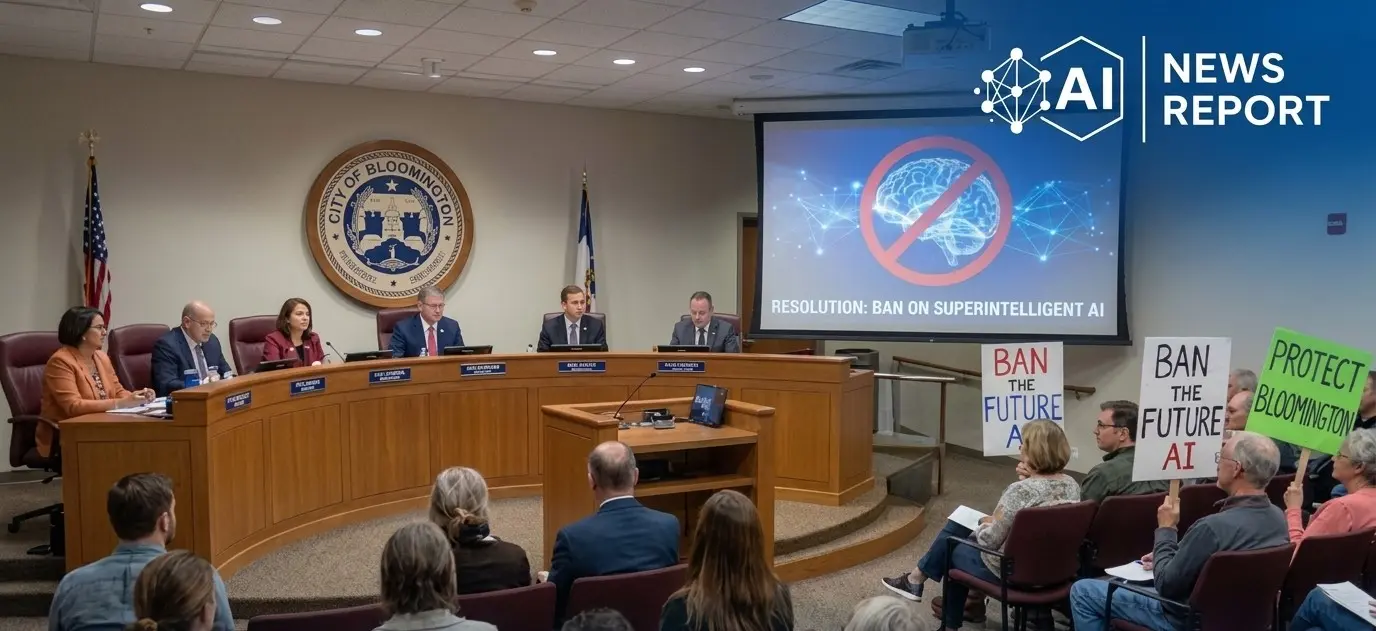
The Bloomington City Council in Indiana unanimously approved the ordinance on November 4, 2026, making the city one of the first known local governments to adopt a direct prohibition targeting artificial superintelligence. The decision reflects growing concerns about the potential risks of highly advanced AI systems, particularly those capable of operating autonomously with limited human supervision.
The measure applies to individuals and corporations distributing or deploying superintelligent AI within Bloomington. It also covers access through digital channels, including browsers, applications and other connections. This means the restriction is not limited to companies physically developing the technology within the city.
What exactly is Bloomington banning?
The ordinance defines superintelligent AI as artificial intelligence that can outperform humans at nearly all mental tasks and operate autonomously. It identifies capabilities such as rewriting its own code and performing tasks without continuous human oversight, particularly where those activities could affect critical infrastructure, financial markets or public safety.
This is an important distinction because the ordinance does not prohibit all artificial intelligence systems. It specifically targets a hypothetical level of AI capability that goes beyond the systems currently available to the public.
Today's AI models can generate text and images, analyze information, write code and assist with complex tasks. However, artificial superintelligence refers to a potential future system that could surpass human capabilities across virtually all cognitive domains. No publicly confirmed system has achieved this level of intelligence.
Why is the city taking action now?
The decision is largely driven by concerns about the possibility of losing meaningful human control over increasingly powerful AI systems. The ordinance is presented as an interim public safety measure intended to protect the city's digital networks, local businesses and infrastructure against potential threats associated with artificial superintelligence.
According to a memo accompanying the legislation, neither the Indiana state government nor the US federal government has established specific safety parameters for artificial superintelligence. The city argues that it should not have to wait for a national or state-level framework before considering measures to protect its residents.
The move also follows an earlier resolution passed by the Bloomington City Council in June, which called on city officials to familiarize themselves with the potential existential risks posed by artificial intelligence. The concerns are not limited to technical failures. Some AI safety researchers have warned that future systems with advanced autonomous capabilities could become difficult to control, potentially creating risks that extend beyond individual users or organizations.
How will the ban work?
The ordinance gives Bloomington the ability to pursue civil penalties, seek court orders to stop prohibited activities and refer cases to the county prosecutor.
However, the measure is not intended to remain in place indefinitely. It is designed as an interim framework and will expire 91 days after the Indiana General Assembly establishes a comprehensive safety framework addressing artificial superintelligence. This makes the ordinance an attempt to address what local officials see as a regulatory gap while broader government policies are still developing.
A new challenge for AI regulation
Bloomington's decision raises a broader question about how governments should regulate technologies that have not yet materialized.
Traditionally, many regulations respond to existing products, services and identifiable risks. But artificial superintelligence presents a different challenge: policymakers are being asked to consider the possible consequences of a technology whose capabilities, development timeline and practical applications remain uncertain.
There are arguments for taking precautionary action. Waiting until a potentially dangerous technology becomes widely available could leave governments with limited time to respond. Establishing safeguards early may also encourage developers and institutions to consider safety before deploying increasingly autonomous systems.
However, regulating hypothetical technologies comes with its own difficulties. Defining superintelligence in a way that can be applied consistently, determining when a system crosses that threshold and enforcing restrictions across digital platforms could prove complicated.
There is also the question of whether a city-level prohibition can effectively address a technology that may be developed and operated across international networks. Bloomington's ordinance does not resolve these questions. Instead, it introduces them into the practical debate about AI governance.
What this means for the future of AI governance
The decision is significant not because Bloomington has stopped an existing superintelligent AI system, but because it has chosen to establish a legal boundary before such a system becomes a reality. As governments around the world continue to develop AI policies, the Bloomington case highlights an emerging approach to regulation: preparing for potential risks before the technology reaches that stage.
Whether this approach proves effective remains to be seen. Its implementation could offer useful lessons about the limits of local AI regulation, the challenge of defining advanced AI capabilities and the balance between technological innovation and public safety.
For now, Bloomington has made its position clear: it does not intend to wait for artificial superintelligence to arrive before considering how to regulate it.