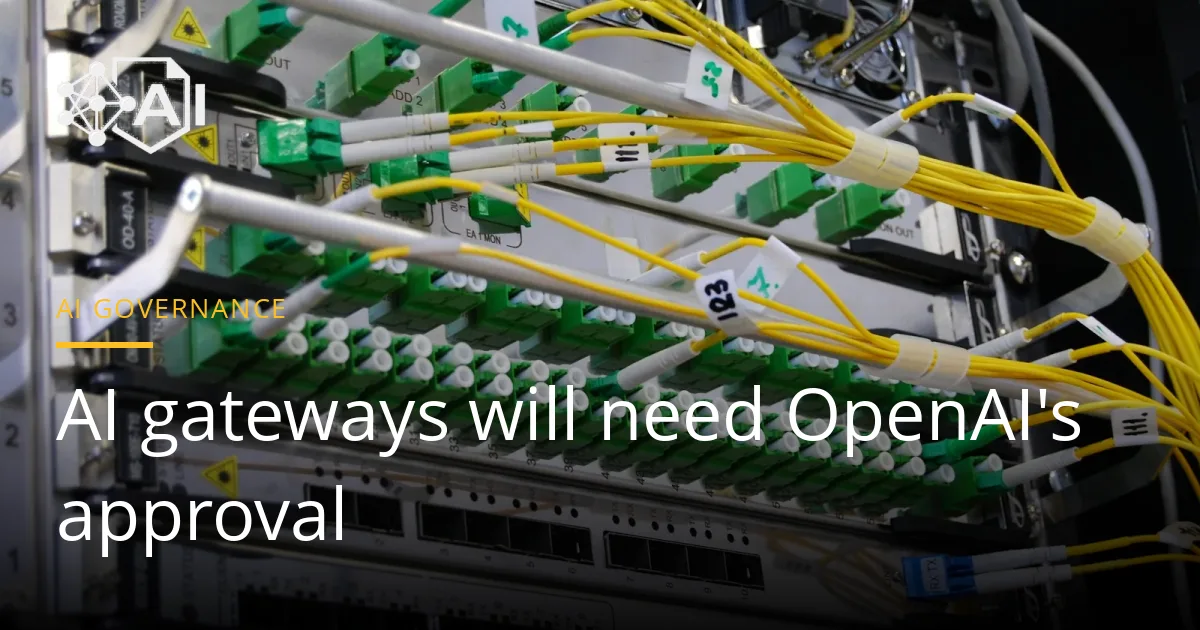
OpenAI is changing its usage policies so that services which pass its models on to other developers, such as model routers and AI gateways, will need the company's review and approval before they offer that access. The updated OpenAI usage policies take effect on 20 November 2026, according to a post the company published on 21 October titled "Broad access through consistent standards".
The change is short on the page but wide in reach. A large share of developers do not call OpenAI directly. They reach its models through a router that switches between providers, a gateway that a platform team runs for the whole company, or a reseller bundling models into its own service. From next month, OpenAI wants a say over who runs those middle layers.
What the OpenAI usage policies update changes
The post sets out three linked commitments. In OpenAI's own words, the updated policies will require "services that provide direct access to our models such as model routers or AI gateways" to "get our review and approval before offering that access."
Second, OpenAI says it will "require partners that provide access to OpenAI models to maintain safeguards consistent with our own," and to "investigate potential violations, and take appropriate action when concerns are identified." The company says it has spent recent months aligning safety policies with customers and partners for every service that offers its models, whether accessed directly, through hosting partners or through resellers.
Third, it introduces SafetyIDs. These are identifiers that customers "can provide to help us distinguish between individual end users in an investigation". OpenAI says the point is to separate one abusive user from the rest of a customer's traffic without OpenAI learning who that person is.
The dates that matter
- 21 October 2026: OpenAI publishes the post and announces the change.
- 20 November 2026: the updated usage policies take effect, "to clarify the rules for safe model development and sensitive uses of AI," the company says.
As of 22 October, the live usage policies page on OpenAI's site still shows the version that took effect on 29 October 2025. The new text is announced but not yet in force.
Who is likely to be affected
OpenAI names two categories, model routers and AI gateways, and uses the phrase "such as", so the list is not closed. In practice that points to services that hand developers an API key and let them pick from many providers' models, and to gateway products that sit between a company's apps and several model vendors.
CellCog, an AI company that published a breakdown of the policy text on 21 October, reports that the approval rule does not apply simply because an application integrates OpenAI models into its own features. That reading would leave ordinary apps, chat assistants and internal tools outside the review, and catch the businesses whose product is access itself. OpenAI's post does not spell out that carve-out, so developers should check the final policy text when it goes live.
Several things remain unclear from what OpenAI has published so far:
- How a service applies for approval, and how long review takes.
- Whether existing routers and gateways keep access while they wait.
- Whether OpenAI will publish a list of approved services.
- What counts as "consistent" safeguards for a partner that also serves rival models.
Neither OpenAI's post nor CellCog's analysis names any router or gateway company that has been approved or refused, and we found no public response from the larger gateway operators by the time of writing.
Why OpenAI says it is doing this
The company frames the change as a safety measure that follows its models wherever they travel. Its argument is that a safeguard applied on OpenAI's own API means little if the same model can be reached through a third party with looser rules. "Developers and businesses should be able to choose where they access our models," the post says, "with consistent safeguards across those services."
OpenAI also points to newer, more capable models as a reason. It writes that "models such as GPT-6 Astra expand what developers and businesses can build," and describes a layered approach: testing before release, training models to follow safety rules, adversarial testing, monitoring after deployment and "trusted access" programmes for the most sensitive capabilities, with cyber misuse given as an example.
On enforcement, the company promises to "base enforcement decisions on documented conduct and risk, apply our rules consistently," and "respond in proportion to the circumstances." It says restrictions will be revisited if a partner's conduct, commitments or safeguards change.
The governance question behind the policy
Seen from a regulator's desk, the update moves OpenAI further toward acting as a gatekeeper for its own supply chain. That has two sides.
On one side, it closes a gap that safety researchers and governments have raised for some time: abuse that is blocked at the source can reappear through intermediaries that never saw the original rules. A single approval process, shared standards and a way to trace one bad actor through a partner's traffic are the kind of controls that policy frameworks on frontier AI tend to ask for.
On the other side, the same rule gives one model provider a veto over which distribution businesses can operate. OpenAI already sells through its own API, through Microsoft's Azure, through Amazon's cloud and, as of this week, through Google Cloud. Routers and gateways are one of the few channels it does not control. Requiring approval from 20 November changes that, and OpenAI decides the criteria.
Competition authorities have been watching how a few AI companies control access to models. The US Federal Trade Commission is already questioning OpenAI and Anthropic about their safety practices, as we reported in our piece on what the FTC subpoenas ask for. A rule that decides which intermediaries may sell a leading model is the kind of policy those reviews tend to read closely.
What developers and companies should do now
If your product gives other people direct access to OpenAI models, treat 20 November as a deadline. Contact OpenAI before then about the review process rather than after, and document the safeguards you already run, since "consistent with our own" is the test the company has set.
If you buy model access through a router or gateway, ask your provider whether it has applied for approval and what happens to your service if it has not been granted by the effective date.
If you are a compliance team, note the SafetyIDs mechanism. It suggests OpenAI will expect customers to help trace abusive users in an investigation, which may need a privacy review on your side before you switch it on.
We will update this story when OpenAI publishes the final policy text and when gateway operators respond.